| MONTPELLIER |
| Montpellier
is the capital of the Department of the Herault, a University town with
a world famous faculty of medicine that is also the oldest. It is the
eighth largest town of France with a population of, 350 000 inhabitants,
of which 55 000 are university students. |
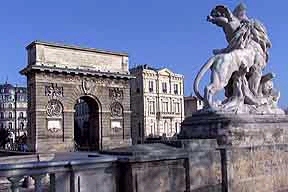 |
| Montpellier has been the
subject of many superlatives and battles with Toulouse for the title of
capital of southern Europe. The town center has many interesting
features not least the modern university buildings, and the old town
with its Arc de Triumph in honour of Louis 14th. |
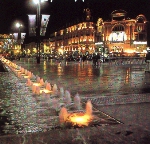 |
The hub of Montpellier is the Place de
la Comedie, known to the locals as "place de l'oeuf", here you
will find the theatre and the statue "les Trois Graces" carved
in white marble. There are many instances in England where Montpellier
has been used to name streets and buildings, the origins of this stem
from the Napoleonic Wars when many English, trapped in France, were kept
in Montpellier. Upon their return to England they used Montpellier,
frequently, to name roads and squares. This is the fifth largest town in
France and its cosmopolitan town center contains an assortment of shops
and many parks and gardens. |
| Under the leadership of its exuberant
Mayor Georges Freches. Montpellier has expanded considerably and edges
ever near the coast, almost certainly to become a coastal town in the
future. |
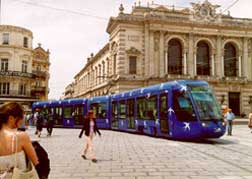
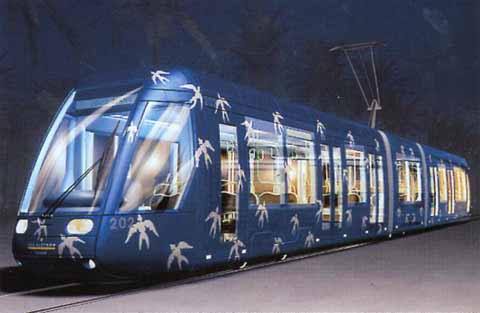
| The latest acquisition of the town is
its state of the art tramway. The first section of line to be built,
runs from the north west at Mosson- La Paillade to the south east of the
town at Odysseum a distance of 15.2kilometers, and has 28 stations. The
trams run from 05.00 to 01.00 and normally there is a waiting time no
longer than 5 minutes between trains. The trains run at a speed of
between 20 km/h and 70km/h The carriages have been built so that there
is no step between the platform and the tram that allows access to all,
including invalides in wheelchairs. |
 |
 |
|
|
|
|
|
|
|
| Cambous |
|
|
|
|
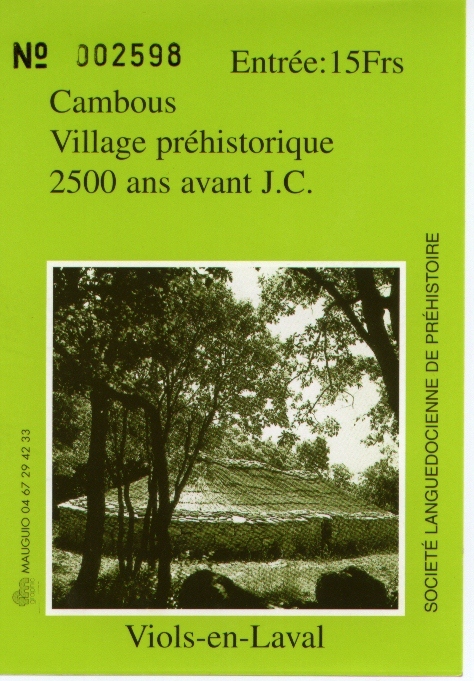
| A short distance from Montpellier lies
the prehistoric village of Cambous, Discovered in 1967. Since that date,
excavations and surveys have exposed many dwellings from the Fontbouisse
culture, a local variety of the copper age, and dated 3000 years B.C.
The site consists of four groups of about ten houses each. One of these
houses has been restored. The houses have a double facing of dry stone
walling and never exceed 1.50m in height. The roofs were supported by
wooden beams wedged into holes running through the middle of the house
and was covered with branches and thatch. Various artifacts have been
discovered including pottery, tools, weapons and ornaments. Hearths were
the inhabitants made a fire is situated in the back of the houses at the
most distant part from the fire. Some hearths were found outside the
building, suggesting that they lived an outdoor life for large parts of
the year. |
 |
| The village spreads over about 5 acres
and is one of several sites know around the nearby village of St Martin
de Londres. |
|
|
|
| St Martin de
Londres |
|
|
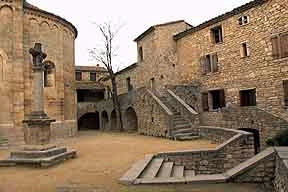
| St Martin is a village
typical of the region and worth a visit to see its clock tower, many of
its roads are stepped. Normally the region is well known for being burnt
by the sun, but St Martin has the distinction of holding the record for
the coldest location of the region with a temperature of -26degs.
Centigrade in 1956. At that time many of the Olive trees of the area
died because of the cold. |
 |
|
|
|
|
| Pont du Gard,
Remoulins |
|
|
|
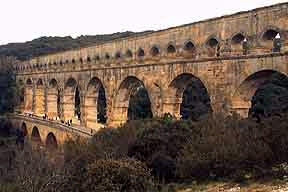 |
A short drive from Montpellier is the
Pont du Gard an aquaduct composed of three levels of arches, 49 meters
high and 275 meters long. Built by the Romans during the 19th century
B.C. to bring water from the Cevennes mountains to the town of Nimes, it
remains in good condition. |
|
|
|
|
|
|
|
|
|
|
